
Changes: The story of my recovery
Those who follow this blog know that I tore my hamstring in late October, just five days before I was to accomplish my dream of running the New York Marathon. I’ve been recovered from the injury for about a month now, but I wanted some space from the process before sharing any lessons learned. I knew the injury – and the recovery that followed – were changing me, and I needed time to reflect on it. While I don’t yet have all the answers, I’m far enough along to know that I feel more enlightened. I’ve gone through an emotional roller coaster from the shock of missing the marathon, to the sadness of an injury that limited my activity, to the fear and hope of getting back up a doing it all again – and then some. I now see that my injury, recovery, and renewed focus on next year’s marathon are profoundly a new journey within my journey. One that I am ready to embrace and approach as someone who has been forever changed from the first go round.
Getting back up
A friend recently shared a book he read with his child who had taken a fall while climbing. The kid did not suffer any physical injuries beyond some cuts and scrapes that were treated at the hospital, but as we all know, the more lasting damage from a fall can come from the emotional scars we face. So my friend and his wife researched books on how to teach their child to overcome fear, and they landed on, After the Fall (How Humpty Dumpty Got Back Up Again). The book is an inspirational message about how Humpty Dumpty – who was ultimately put back together by all the king’s men – learned how to overcome his fear of climbing and get back to doing what he truly loves. The story ends with the message, “Life begins when you get back up.”
While I am not at all afraid to keep trying on this journey to run the New York Marathon, each failure I’ve gone through leaves some doubt – whether in the past from realizing I didn’t have a body capable of running to the present where I was so close and experienced just how fragile this all is. And each new attempt at accomplishing this goal represents a new beginning – a chance to start over.
The good part about a new beginning is time. It’s a long process, and assuming the goal is a realistic one, there are no requirements for where you need to be when starting out. That’s where to take comfort because pretty much everything else about a beginning is uncomfortable.
The beginning of this process involved putting myself back together again, finding a fitness routine within the confines of my injury, and dealing with the natural decline that inevitably came from a lighter load of activity. It came at a time of vulnerability. Beginnings happen outside of my comfort zone. That’s what getting back up is all about.
I can’t do it all alone . . .
Those who know the story of my fitness journey know that it started with a personal trainer, Paul, who turned my lifestyle around. Just over six years into our training, the pandemic hit and Paul retired as a trainer. Together, we had reached so much more than I ever could have imagined, and with the knowledge and motivation that grew out of our relationship, I told Paul that I got it from here.
I was ready to employ all that I had learned and to continue learning as I trained myself for the first time. Partly out of fear of declining and partly due to the lack of other options during the pandemic, I found that I could push myself even harder than I had been training before. An hour of strength training turned into two hours, and I’d follow that with cardio. I knew where my peak had been, and I was determined to prove that I could exceed it on my own. And I did.
But as I entered marathon training, I quickly found that I was thrusting myself into something new and largely unfamiliar. I had some knowledge of the type of single-leg strength training that goes into marathon preparation, but not nearly enough. I mostly checked the boxes when it came to doing strength work in my training plan, but I was limited in my understanding of it all. When it came to skipping a workout, I always skipped the strength over the run when I should have done the opposite. I went into marathon training a novice at it all and did what I could to learn and stay afloat. In many ways, this crystalized for me that, in my fitness, I had gotten myself as far as I could alone. But because Paul set the bar so high for what I can achieve with a trainer when we both commit to each other, I also knew that finding the next great one was no guarantee.
Now fast forward to after my injury and starting physical therapy. This wasn’t my first time ever going to PT, but in the past, it simply boiled down to a few weeks of going through the process until I was healed. Do the work. You are healed. You are done. This time was different. This time my physical therapist, Auren Manalo, became so much more than the medical professional who got me through the process of healing. He’s become the next great mentor and coach in my fitness journey. I landed with Auren through a combination of timing, recommendation, and fate (more on that will have to wait for another post).
Auren trains athletes and marathon runners which is a great fit for my fitness lifestyle. But the greats in my fitness journey are not made by credentials alone. It is because, for whatever reason, I’ve been lucky to have each of them show a dedication to me. Each great that’s been part of this journey is a reminder that I could never have done any of this alone – something I had lost sight of.
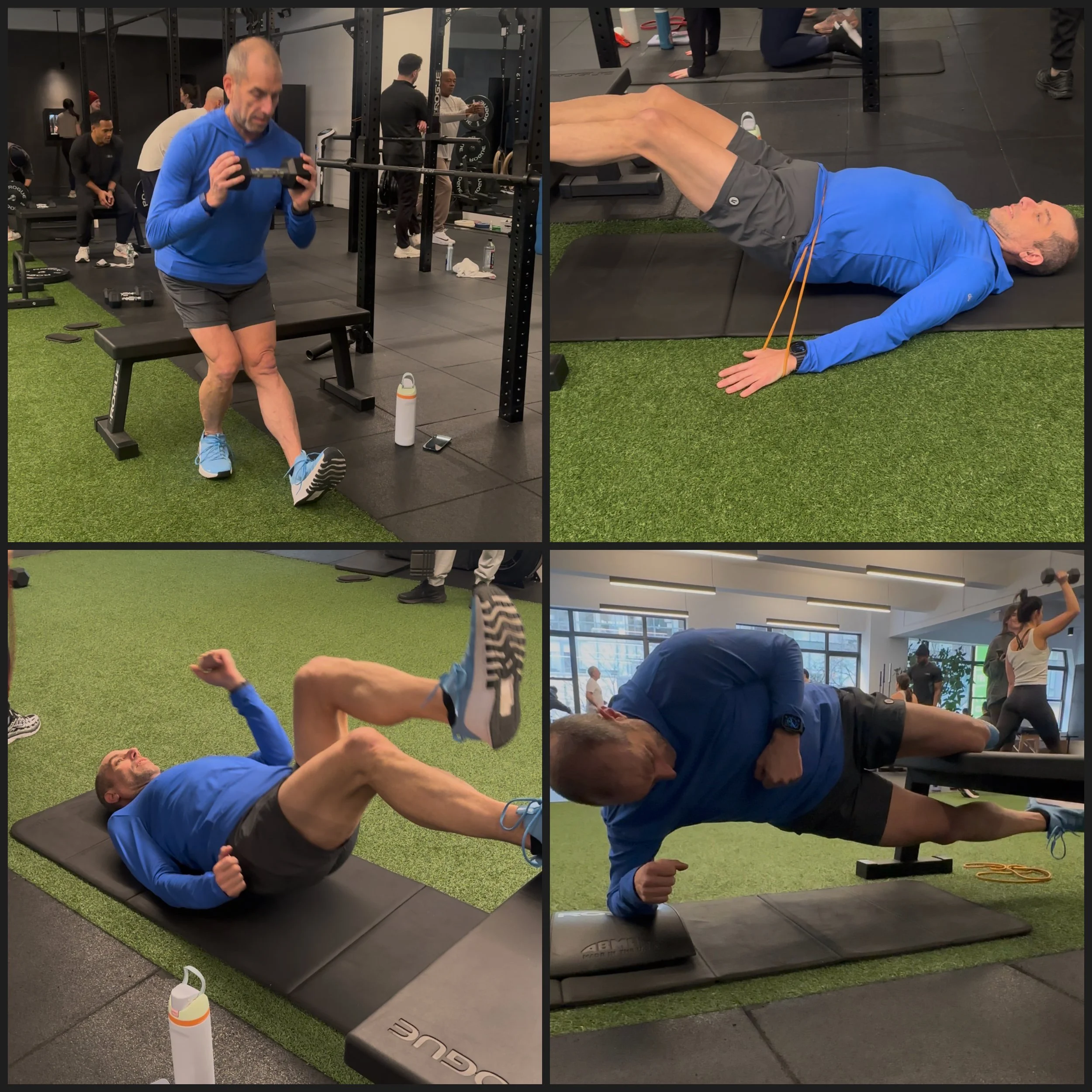
Auren and I worked together through my recovery, and now – having been healed for over a month – we are working through the marathon and beyond. The mission: train for running and climbing. As I wrote about a month ago, I’m serious about big wall climbing too. As Auren says, now we’re working on making me bullet-proof. We’ve evolved from the weekly sessions aimed at healing the torn hamstring to every few weeks of examining the state of my body and planning for the next cycle. After each session, he sends me a detailed and personalized work out plan that is a stable of my routine. With each one, I aim to crush it so that the next plan goes beyond it. And with each plan, I feel my body getting stronger – and more stable – than ever.
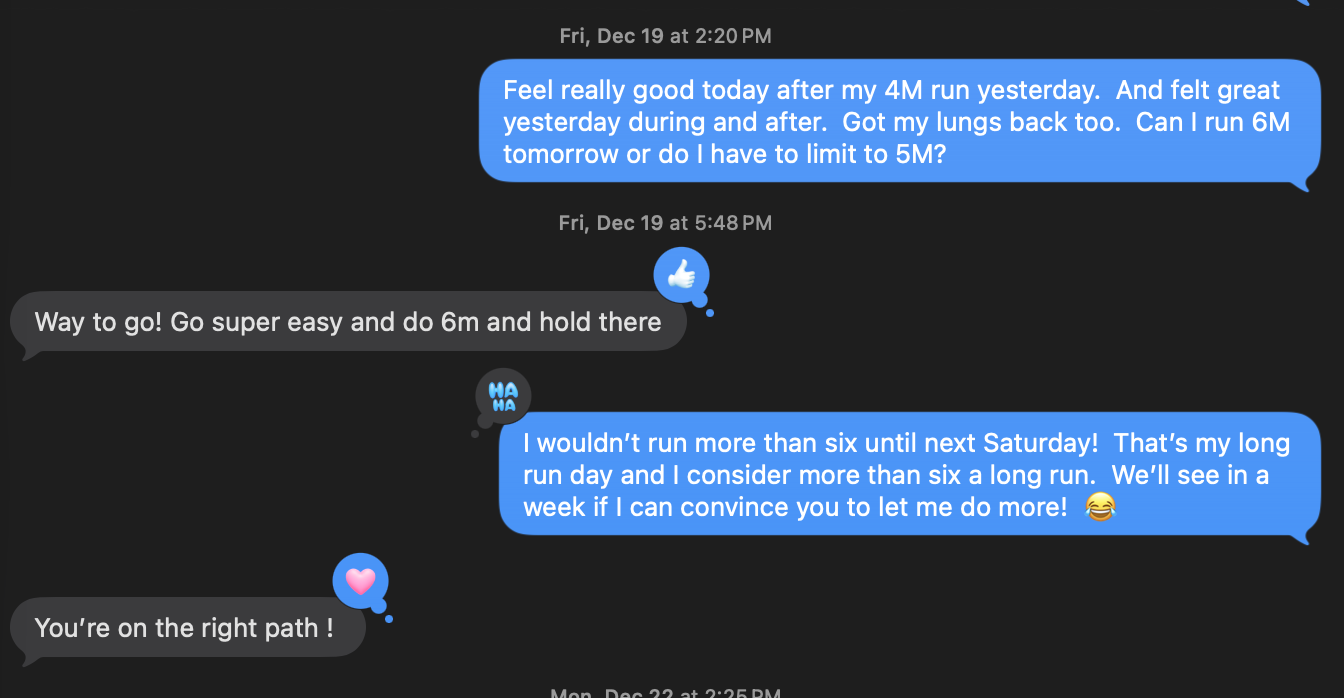
But beyond the plan I get from Auren, I have found someone who helps me know when it’s good to push harder and when I need to be reigned in. Someone who has shown an investment into my process. Sometimes, it’s as simple as checking in while building up my running routine post-injury . . .
Other times, such as this past Saturday, it’s taking the time to send me just what I needed after quitting on a run for the first time ever . . .
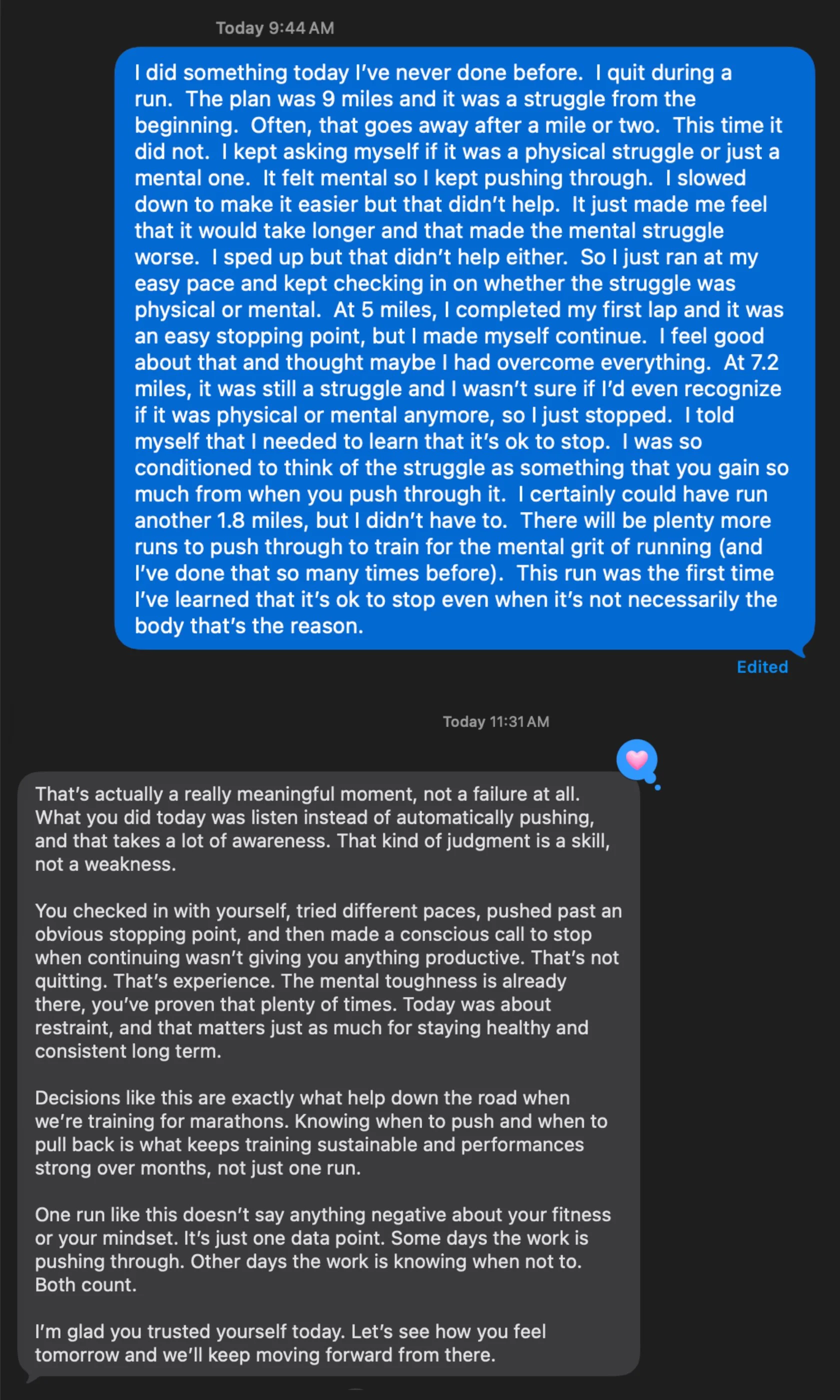
Deep down, I already knew everything Auren said, but I need it to be affirmed too. I needed it from someone who would not only tell me this, but who would also have told me if I should have pushed harder. Thank you, Auren!
All that said, my experience is everything . . .
Along with Auren’s guidance in the text chain above, you can also see just how much I learned last year and how I changed from it. 2025 was basically a crash-course in marathon training. I’m a different runner now than I was a year ago. Before I started training in June and running four days a week, I was a one or two day-a-week runner. I ran four days per week during training because that’s what the plan I chose said to do. I didn’t have the experience to know whether it was too much or just right. I didn’t know when to skip a run or that I didn’t need to finish each one. My mentality was to push through everything. I was focused more on preparing for the mental grit I would need during the last few miles of the marathon than I was on what my body was going through. Never was my focus on avoiding the need for that grit in the first place. Unless an actual injury happened, I assumed everything my body was feeling was how it was just supposed to feel during a rigorous training plan. I know better now.
Here are just some of the many more things I know now that I did not know a year ago:
I know how it feels to train for a marathon
I know how to fuel before, during, and after runs
I know it’s ok to take a run day off.
I know it’s ok to take two run days off.
I know it’s ok to take however many run days my body says to take off.
I know I can run 20 miles and that I could have run even more.
I know that pace does not matter at all to me.
I know that I love running.
The experience I gained last year is everything.
The emotional process . . .
All that said about my experience, I also know how fragile this is and that I will be dealing with last year’s heartbreak until I cross the finish line. Since my injury, I’ve had time to process the shock and pain. That doesn’t mean it’s gone. But it fades and goes into different phases. At first, it was the immediate sorrow of missing out on the race. The absence of completing the mission. And the emptiness of missing out on the reward from all the training that went into it. Then came the sadness of not being able to run after the injury. The days of wanting to do more than my body could. But as my body improved, the sadness went away only to be replaced with fear. As optimistic and hopeful as I am – and I am – I can’t deny the fear inside of me that something might go wrong again.
During my training last year, I wrote about the power of visualization and how often I saw myself running the marathon and crossing the finish line. Now, I go out for a run, but I’m at a time where the vision is less clear. Sometimes I even take my mind back to that moment where my hamstring tore, and I have yet to actually run that part of the Park because it’s still too raw.
I don’t think there’s anything wrong with this fear so long as I use it the right way. In many ways, it goes back to the story of Humpty Dumpty and my friend’s kid who fell during a climb. When I asked him if his child wanted to climb again, he said that the kid answered, “yes, but with a helmet and knee pads.” That’s how fear and optimism can work together for a better result. Don’t let the fall take away your passion but allow it to make you better at achieving it.
I’m now using my fear to apply the lessons learned from this injury. I use it to get stronger and train smarter. I won’t allow it to prevent me from continuing to climb towards my dream, but it does guide me to be better at pursuing it.
Where I am right now . . .
Whether I had finished the marathon on November 2 last year or not, I was certain to take some time to reflect on the experience. The injury simply forced me to be more analytical and granular about everything. I won’t say it made me think about what I did wrong, but rather what I would do differently. If I made mistakes, they were simply teaching moments. But one of the biggest lessons learned is the need to adapt any training going forward to who I am and what my body can handle.
Who I am is more than a runner. Yet, during marathon training I leaned into making running everything. I sacrificed climbing, golf, and other activities for my training – or worse yet, I sometimes doubled up on them to squeeze it all in. Sometimes the sacrifice is necessary. I have to train. Other times, it’s not, and I need to give it a rest. I don’t need to run 4 or 5 miles before I spend a 7-hour day climbing in The Gunks. A one-size-fits-all marathon training program doesn’t take me into account.
One of the lessons learned is that I’m already fit enough to run this thing. I just have to keep it up. My love of running will take me that far as long as my body holds up. And therein lies the key lesson. Training is not merely about getting in shape to run 26.2 miles, it’s about keeping my body strong enough, stable enough, and as bullet-proof as possible to do it – all while being a climber, golfer, swimmer, and so much more. That’s who I am, and that’s how I will train. With help.
Four weeks after my injury, I was climbing again in the gym. After six weeks, I ran for the first time. And now I’m back to it all. Strength training, running races, long runs, and even getting in my first ever day of ice climbing!
I believe I’m coming through this stronger, healthier, and better than before. And to put even more of a silver lining on it, I truly believe that I’ll be a better runner going forward than I would have if I had finished the race in November. A good outcome does not necessarily mean you did it right, and a bad outcome doesn’t always you did something wrong. Shit happens. We learn. We move on. And we get better. And even with the heartbreak and fear that still take their space in my psyche, I know that I will finish the marathon – at exactly the right time I am supposed to. After all, everything happens for a reason.
Aaron