
Yosemite (Part 4): My journey to El Capitan
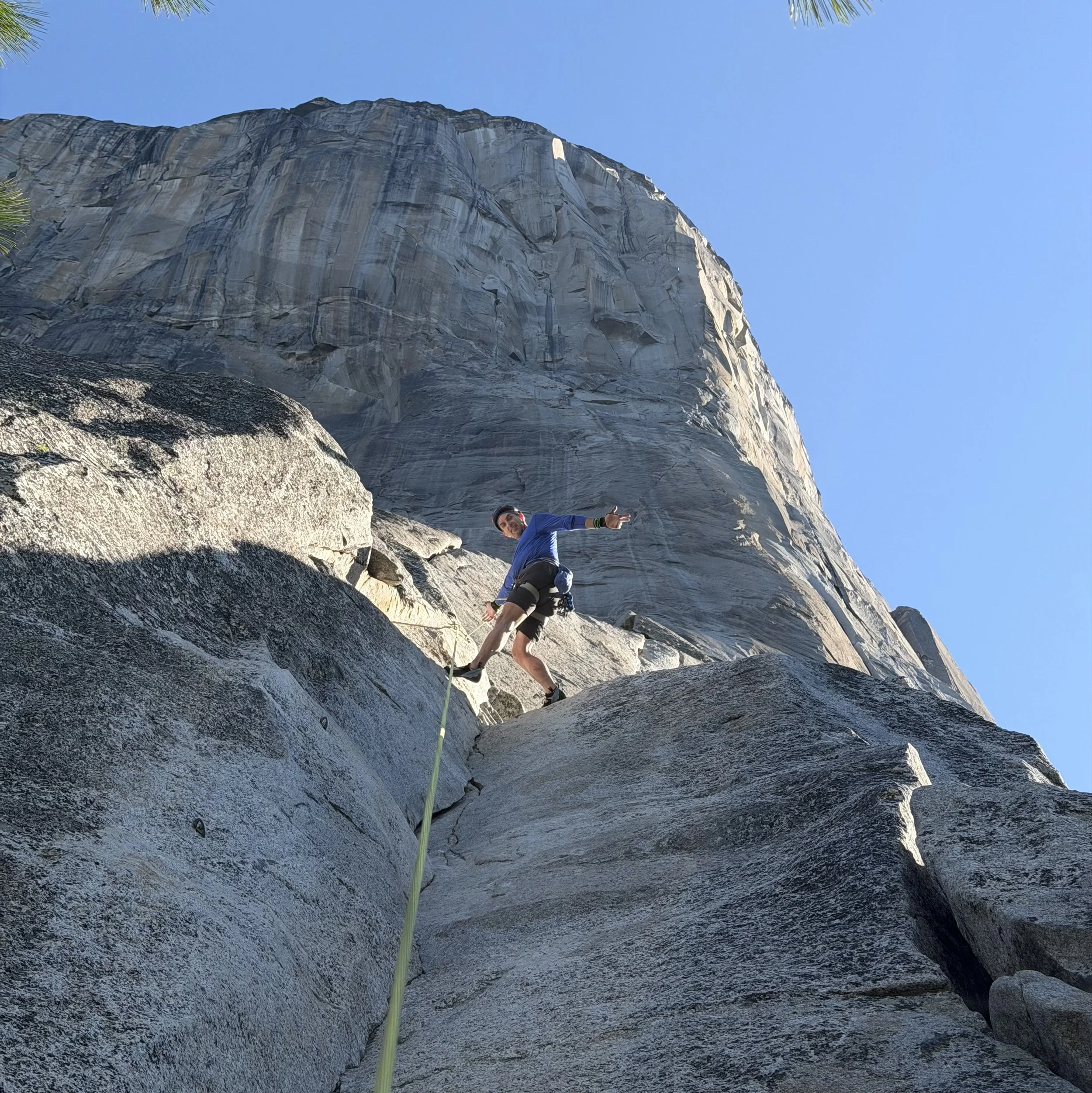
It’s taken me to the final post of this series to get to the most important part – the climbing! Friends of the blog have seen my passion for this sport evolve over the three-plus years since Legally Fit first launched. What began as a hobby that I started just three months before my first blog post has become the focus of one of my biggest ambitions yet. My progress in climbing came quickly at first, allowing me to imagine endless possibilities. But I later learned that progress is not linear. At times I thought I should be much further advanced than I was. At others, I was beyond what I expected. The fact that this evolution occurs more often by failing than succeeding is why it’s good to try to fail big in climbing. So, why not try to “fail big wall?”
Setting the dream in motion
As I wrote late last year, my dream is to climb El Capitan. As my guide, Garet, also told me, “That should be every climber’s dream.” But before I get too far ahead of myself, I set out on this trip expecting it would be the first of many to Yosemite as I work my way toward climbing this big wall. This first trip was simply to feel the granite and experience climbing in this Mecca. There’s so much to learn – how hard the climbing is; how to aid climb (a necessity for big wall climbing); how to handle sleeping on a portaledge well over 1,000 feet above the base. But first, I needed to know what I would feel when I first set eyes on El Cap. I had no expectations of climbing on it this trip, but I needed to stand before it and take in this mission. Would it inspire or intimidate me? Would it look doable or impossible? Will this endeavor continue, or will that moment be the end of this goal? Is this a dream or just a fantasy?
Garet knew my aspirations before we started our journey together, and I gave him a candid assessment of how far I might be from achieving it. Deep down, I hoped I could reach it in another three to five years if Father Time allowed – but that timeline was based on little more than knowing I wasn’t ready yet. Then, as I approached Yosemite on my drive from San Francisco International, Garet shared the plan for our first day . . .
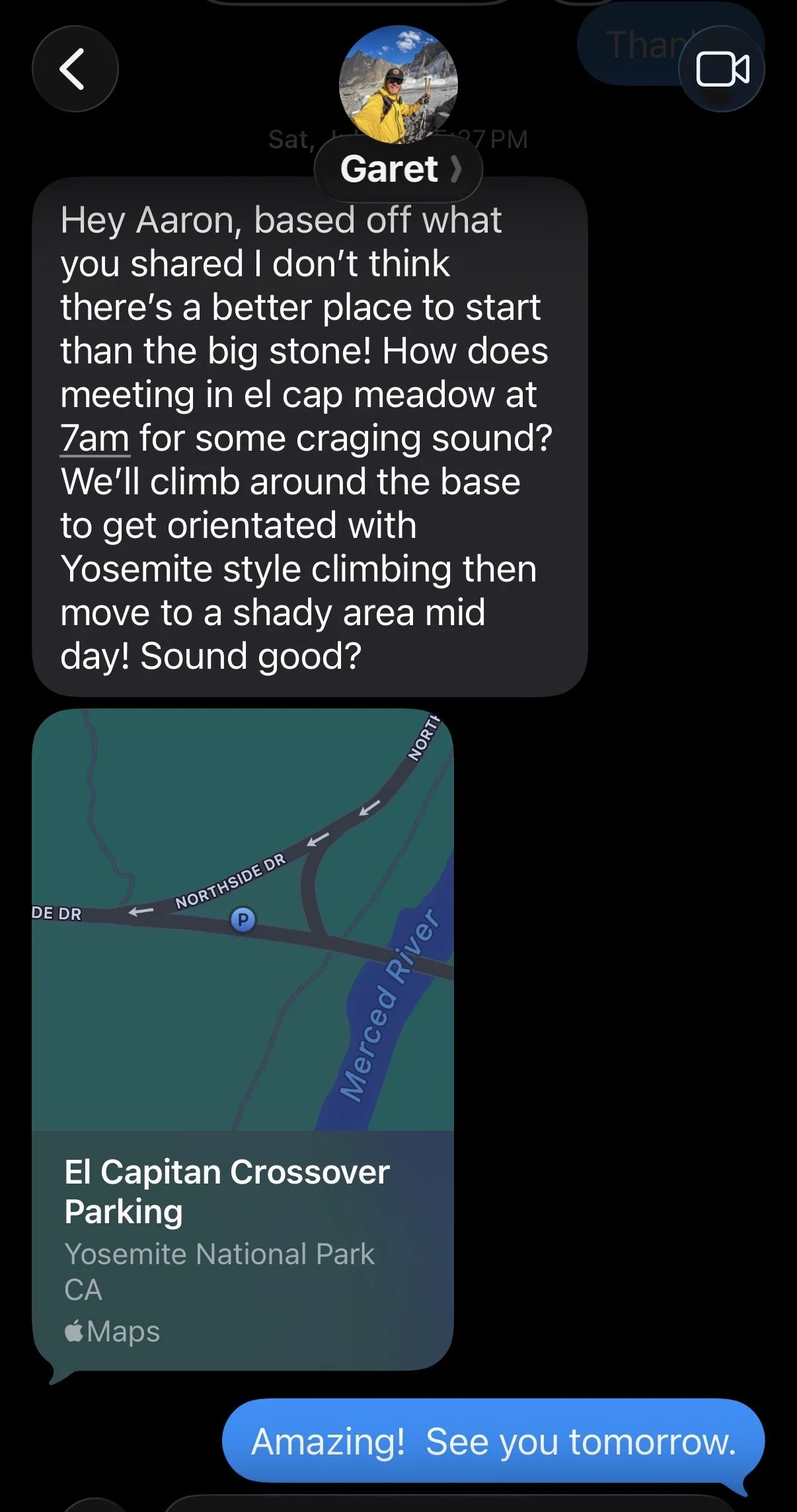
It just got real. I had planned a full week in Yosemite and thought maybe by the end of it, I could convince my guide to take me on El Cap. I could take in all of Yosemite throughout the week before facing the ultimate reason I was there. Yet here it was on day one. It took me a moment to compose myself before responding to Garet’s text.
As the morning approached, I was full of excitement and fear. I was excited to climb on El Capitan. But I was afraid that, within hours, everything else I envisioned would end.
Feeling the big wall . . .
The first challenge was simply to stand before El Cap and take in the enormous endeavor I someday hoped to achieve. It was breathtaking. It is a sight to behold regardless of why you’re there, but imagining my journey to the top made the experience even more powerful. Mostly, the question I kept asking myself was, “Does this look doable?” The answer changed from minute to minute depending on the exact spot from which I was looking at it and how the sun’s rays hit it. One moment, I would think, “Sure, that looks like it can be done.” Yet, only a few seconds later, it looked impossible.
After taking it in, it was time to start climbing. Time to touch rock in Yosemite – and of all rocks, El Cap. We started up The Nose – the route that would be what I climb to the top someday – and moved around to a few other pitches. I had a lesson in aid climbing – which is the most important skill I need to be able to make it to the top. In all, we spent about three hours on the wall before we had to pivot to catch the shade on the other side of the Valley. What I remember most is the feeling of being comfortable on El Cap. No, not actual comfort. The rock was sharper than anything I had experienced before as layers of skin peeled off my fingers. And no, I didn’t get so high as to experience how the exposure felt above 1,000 or 2,000 feet. The comfort I felt was that I belonged there.
The journey I’d started just three years earlier had brought me here, and my first experience on El Cap was everything I’d hoped it would be. I climbed routes up to 5.9 and found them surprisingly easy – though it may not look that way to an outsider . . .
In The Gunks – where I’ve done most of my climbing – the grades of each route are known to be “sandbagged.” A 5.6 there could be a 5.9+ elsewhere. I’ve climbed 5.8s in The Gunks but failed at most of them, and I was expecting Gunks-level grades in Yosemite. Instead, I was filled with confidence when I was able to climb 5.9s with relative ease. After three years of my climbing journey and testing myself outside of my usual environment – from Moab to Yosemite – I realize that I'm capable of more than I expected. A year ago, I still thought of myself as a beginner – or advanced beginner. Now, I feel I’ve progressed far beyond that level. By comparison, for those who golf, I’m now regularly breaking 90 and sometimes 80 on the tough courses. As is also the case with golf, there’s still lots more room to improve. But I now know that I can play – or in this case, climb – almost anywhere! And having a guide lead me up the rock while I follow by aid climbing is a little like getting strokes on every hole. Especially since I nailed the aid climbing lesson.
Lower Yosemite Falls: A theater where I became the show
Garet and I finished the day at Lower Yosemite Falls, an area filled with tourists and hikers. We were the only ones climbing there at the time, as most climbers spend the hottest summer months in the higher ground of Tuolumne Meadows. What I quickly realized while climbing in this arena – where I finished on the only route of the week that I failed at, a 5.10b – was that we had an audience. Over four million people visit Yosemite each year, but less than 1% of those are rock climbers. I went there to experience the theatre of climbing and soon realized that I was part of the show. In fact, while climbing – and struggling – on Guiding Light (5.10b), I could hear a hiker below telling my guide, “You couldn’t pay me to do that.” My guide responded, “Well he paid to do this!” It was fun to be the tourist attraction.
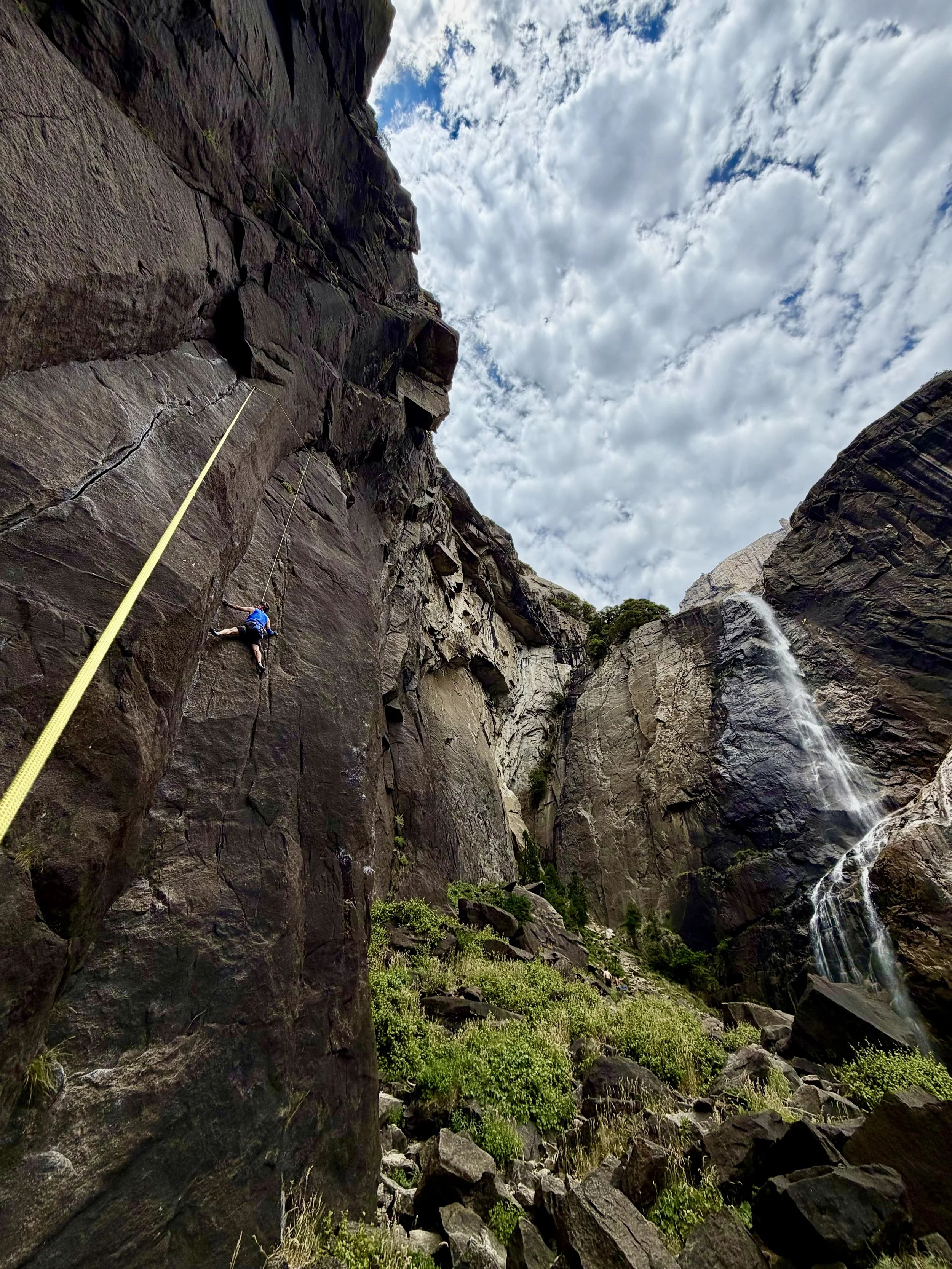
Guiding Light (5.10b)
My time climbing with Garet for this trip ended that day. As I mentioned earlier in this series, our second day together was rained out. His days off were on my later climbing days, but we met up on the canceled day and discussed the outlook for my journey. More on that in a bit.
Two days in Tuolumne Meadows . . .
Although I would not climb with Garet anymore on this trip, I spent two days climbing with his colleague, Jake. For the remainder of the trip, we climbed in Tuolumne Meadows where the temperatures were much more bearable. We climbed in the 5.6 range with the simple objective of sending some fun routes. The first day was on my birthday and was the day after my Half Dome hike. This time, the mission was not to fail big. It was a leisurely climb up Dozier Dome where, once we reached the summit, we could enjoy an afternoon swim in Cathedral Lake.
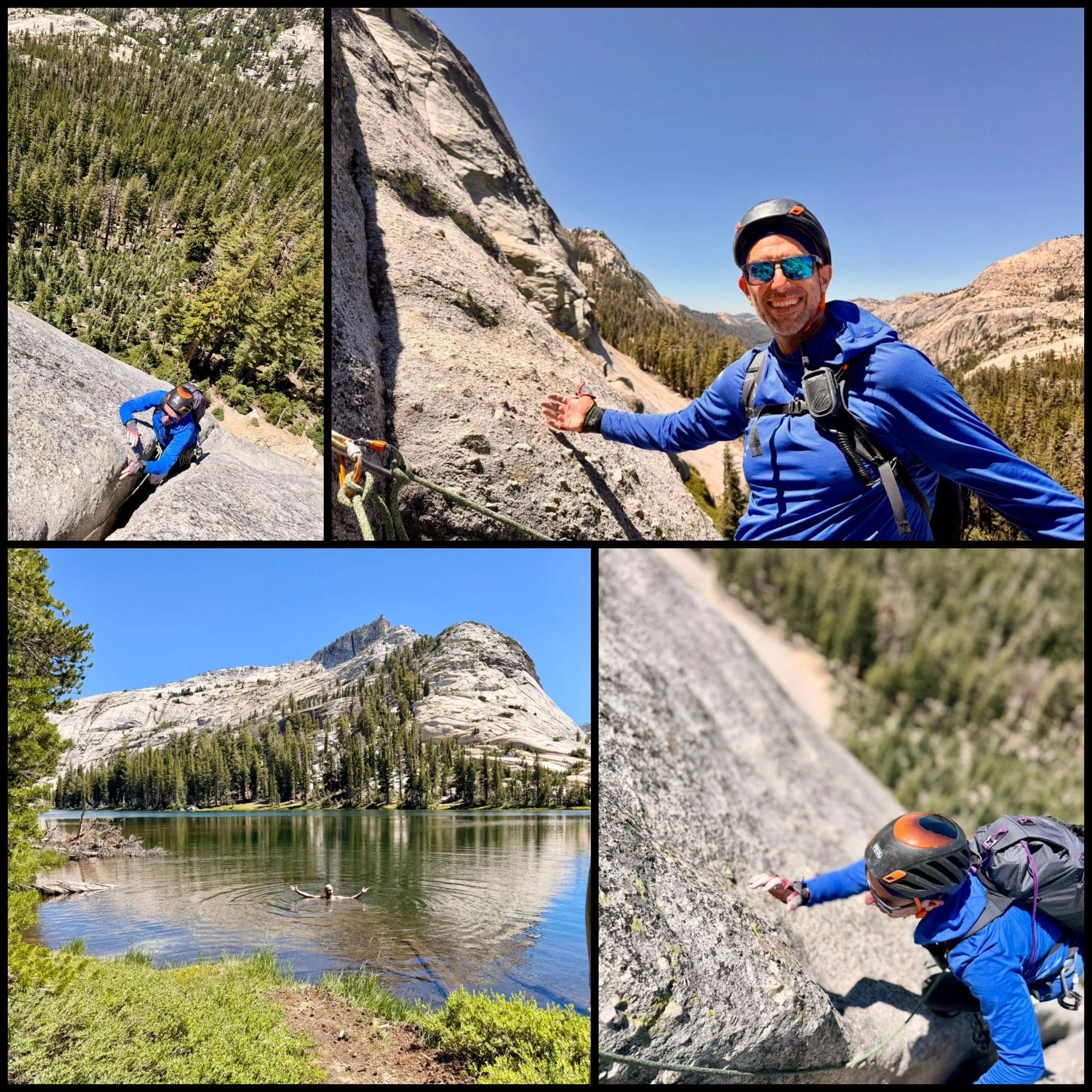
Climbing Holdless Horror (5.6) on Dozier Dome and a cool down swim in Cathedral Lake
On my final day with Jake, we climbed one of Yosemite's classics: Cathedral Peak. After a two-hour hike, we made our way up the rock toward a tiny summit with spectacular views. It was a climb that filled me with confidence as we breezed up past dozens of other groups. The mountain offered several routes to the top, but the final pitch narrows and forms a bottleneck. Despite several groups starting ahead of us, we reached the summit first. By the time we descended, dozens of climbers had gathered below, waiting to climb the final pitch. For the first time, I made speed part of the objective, and I breezed through the 5.6 climb. At the top, I asked Jake if I could stand on the tip of the peak. “Of course! Most people are too scared to do it.” I told Jake I’d practiced the night before by standing on the night table in my Airbnb. It was my first time standing on the tip of a peak not much bigger than a stool, and I relished the moment that completed my climbing journey for this trip. But that’s not the end of my Yosemite journey.
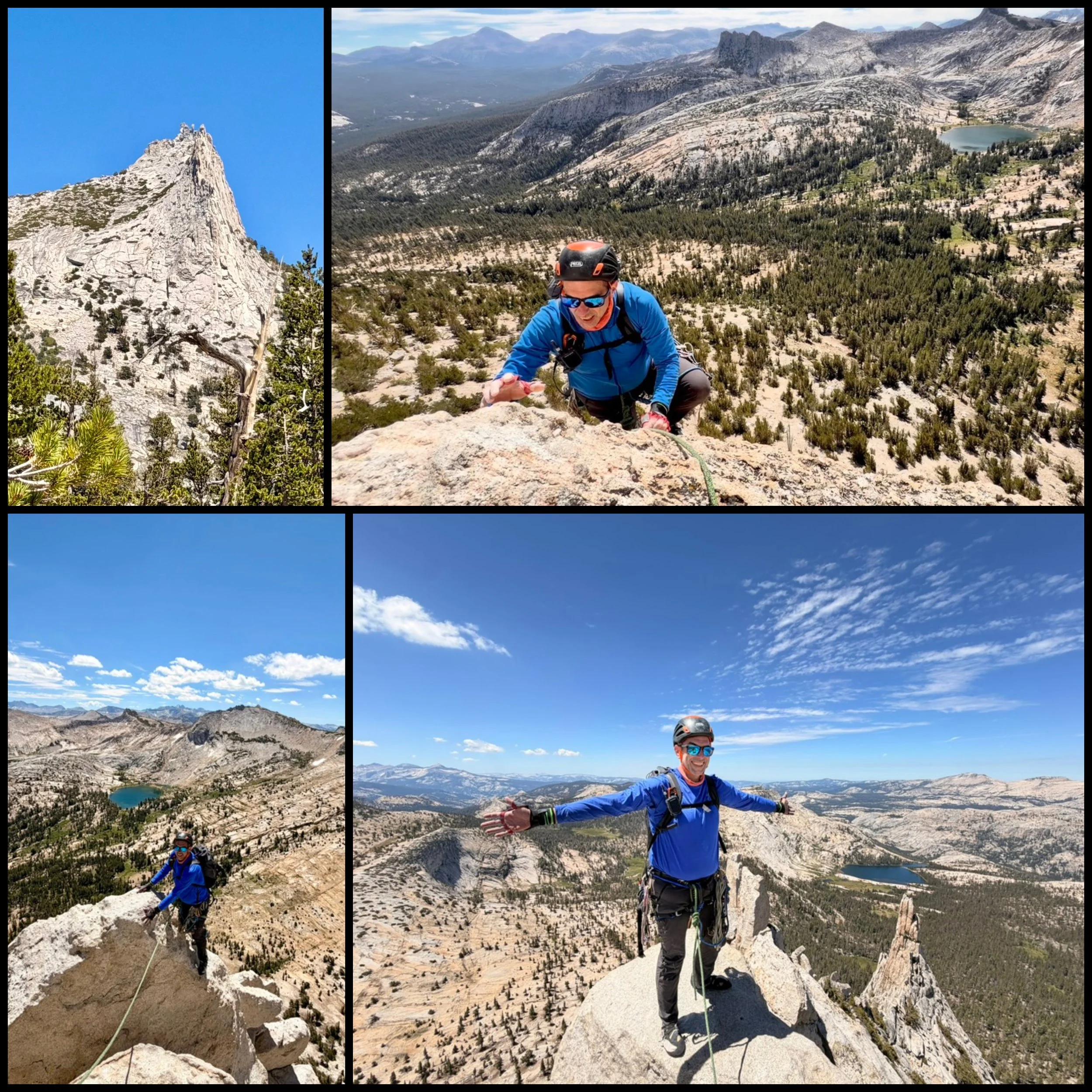
Cathedral Peak (5.6)
The Plan . . .
Now back to that talk with Garet . . .
As Garet and I met on the morning of the day we'd lost to rain, he was disappointed that we wouldn't be climbing together again on this trip. We both were. But he had something important to share – how much he'd enjoyed climbing with me and how much he wanted to be part of my journey to the top of El Capitan. We'd connected on the rock, and I was ecstatic to hear this. But my first question was simple: "What do I need to do to get to that level?" His answer shocked me.
“You are already there!”
Garet explained that our plan for El Cap was for him to lead while I followed by aid climbing, with him hauling our bag up each pitch. Someday, I might also share in leading a climb up the wall with a partner, but this experience with Garet will fulfill my dream. He explained that, while I could go straight to our climb up El Cap, ideally, we would complete this journey over two more trips. The first would be a shorter big-wall climb , lasting one-night, so I could experience sleeping on the rock. The following would be our four-to-five-night climb up The Nose on El Capitan. Our plan now is to do the first big wall next fall and to summit El Cap the following spring.
As I look back on my first desire to climb El Capitan, I know that, at the time, it felt far more like a fantasy than a realistic goal. But in a sport where failing big is part of the path to success, one must dream big too. Yet dreaming big is only a small part of it. It requires an open mind and imagination. Making it happen requires courage. I began thinking about climbing El Cap before I even knew whether it was possible for me. Within a year, I'd turned that thought into a mission and planned a solo trip to Yosemite that had all the potential to blow up in my face. Of course, I knew I'd enjoy Yosemite. But enjoying the park wasn't the purpose of this solo trip. I wanted to learn more about my potential—or, more accurately, my limits. In Part 1 of this series, I wrote about my hopes and dreams. What I didn’t share were my expectations. If I’m being honest, I expected to fail. I thought Garet might sit me down and explain that El Capitan is not for me. Or perhaps I’d realize it the moment I stood before the wall. I expected to have to share with you that this dream wasn’t going to happen. At most, there might be a lesson about how it was worth trying anyway. Instead, I left Yosemite with a plan to climb El Capitan and a partner to climb it with.
Aaron
PS: Links to each part of my Yosemite blog series are below:
Yosemite (Part 1): My hopes and dreams
Yosemite (Part 2): Clouds Rest – A lesson in fear and preparation
Yosemite (Part 3): Half Dome — A twist of fate
PPS: Here are my Instagram reels that compliment Parts 2, 3, and 4 of the blog series
Part 2: Clouds Rest
Part 3: Half Dome
Part 4: El Capitan